In-situ testing represents a cornerstone of geotechnical engineering in El Paso, encompassing a suite of field-based investigation methods that evaluate soil, rock, and fill material properties directly in their natural, undisturbed state. Unlike laboratory tests performed on extracted samples, in-situ techniques capture the true stress conditions, moisture regimes, and stratigraphic complexities that define the region's challenging subsurface environment. For engineers and contractors operating across the Paso del Norte corridor, these methods provide critical data for foundation design, slope stability analysis, and earthwork quality assurance. The category spans everything from strength and deformation assessments to permeability measurements and compaction verification, each tailored to the specific geological formations encountered beneath the Chihuahuan Desert floor.
El Paso's unique geological setting makes in-situ testing particularly indispensable. The city rests upon a complex interplay of Quaternary alluvial fan deposits, ancient Rio Grande floodplain sediments, and weathered bedrock from the Franklin Mountains. These materials range from dense, cemented caliche layers to loose, wind-deposited silty sands prone to collapse upon wetting. The presence of expansive clays in certain basins, coupled with shallow groundwater in the river valley, creates conditions where traditional sampling alone often proves insufficient. In-situ methods such as the field density test (sand cone method) become essential for verifying engineered fill placement, while pressuremeter and dilatometer tests reveal the true stiffness of interbedded strata that would be difficult to replicate in a triaxial cell.
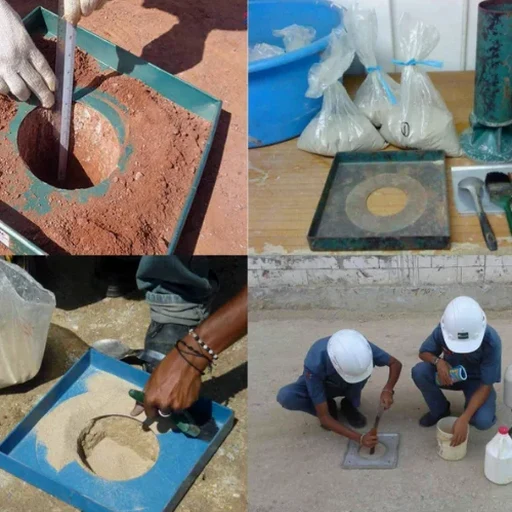
Regulatory compliance in El Paso falls under the City of El Paso Building Code, which adopts the International Building Code (IBC) with local amendments, alongside Texas Department of Transportation (TxDOT) standards for roadway and infrastructure projects. Chapter 18 of the IBC mandates geotechnical investigations that typically require in-situ determination of soil bearing capacity, liquefaction potential, and compaction characteristics. ASTM International standards govern the execution of most field tests, with ASTM D1556 for sand cone density testing and ASTM D1586 for Standard Penetration Testing being routinely specified in project documents. The El Paso Water Utilities also enforces strict compaction criteria for utility trench backfill, often verified through nuclear gauge or sand cone methods per ASTM specifications.
The range of projects requiring comprehensive in-situ investigation in El Paso is extensive. Large-scale residential subdivisions in fast-growing areas like Eastlake and Horizon City demand thorough compaction testing and bearing capacity verification to prevent differential settlement in expansive soils. Commercial developments along the I-10 corridor, including warehouses and logistics centers, rely on plate load tests and cone penetration testing to design slab-on-grade foundations capable of supporting heavy racking systems. Critical infrastructure such as the Bridge of the Americas expansion and border wall segments has necessitated advanced in-situ shear wave velocity measurements for seismic site classification. Even smaller projects like retaining walls and solar farm installations benefit from field permeability tests to manage drainage in the area's flash flood-prone arroyos.
Available services
Quick answers
What is the difference between in-situ testing and laboratory testing in geotechnical engineering?
In-situ testing evaluates soil and rock properties directly in their natural position, preserving stress states, moisture conditions, and fabric features that are inevitably altered during sampling and transport. Laboratory tests on extracted specimens provide controlled, repeatable measurements but may not represent field behavior accurately, especially in sensitive or heterogeneous deposits. A comprehensive site characterization program typically combines both approaches to cross-validate results and develop reliable design parameters.
Which in-situ tests are most commonly specified for foundation design in El Paso's alluvial soils?
Standard Penetration Testing (SPT) remains the most frequently specified method for preliminary site characterization in El Paso, providing disturbed samples and blow count correlations for bearing capacity and liquefaction assessment. Cone Penetration Testing (CPT) is increasingly preferred for its continuous profiling capability in the silty sands and clays of the Rio Grande Valley. Pressuremeter tests offer direct modulus measurements critical for settlement analysis in the city's variable alluvial fan deposits.
How do local geological conditions in El Paso influence the selection of in-situ testing methods?
El Paso's subsurface features cemented caliche layers that can impede SPT sampling and require pre-drilling or alternative methods like CPT with pore pressure measurement. Expansive clay zones in basin areas demand in-situ moisture and density profiling to assess swell potential. The presence of shallow groundwater in river-adjacent projects necessitates careful selection of tests like field permeability and vane shear to evaluate drained versus undrained behavior accurately.
What ASTM standards govern in-situ density testing for earthwork projects in the El Paso area?
ASTM D1556 outlines the sand cone method procedure widely used for field density verification on El Paso construction sites, while ASTM D6938 covers nuclear gauge methods accepted by local building officials. TxDOT specifications often reference these standards for roadway embankment control. The City of El Paso typically requires testing at frequencies defined by project geotechnical reports, with results compared to laboratory maximum dry density values from ASTM D698 or D1557.